
You might think ergonomic keyboards are just pricey gimmicks, but they actually cut wrist strain and boost typing speed. Now, if you want a split layout with hot‑swappable switches and Bluetooth, the Adesso EasyTouch 1500 fits that bill; if you prefer a compact ortholinear design, the YIVU CORNE V4 delivers precision in a tiny 40% case. Here’s the thing: each model shines for a specific workflow, so pick the one that matches your desk setup and typing style, and you’ll feel the difference instantly.
| Adesso EasyTouch 1500 Ergonomic Mechanical Keyboard (Cherry Red RGB Bluetooth) |  | Versatile Performer | Layout Type: Full‑size 104‑key QWERTY | Switch Type: Cherry Red mechanical (hot‑swappable) | Connectivity: 2.4 GHz wireless, Bluetooth, USB‑A wired | VIEW LATEST PRICE | Read Our Analysis |
| Redragon K552P TKL Mechanical Gaming Keyboard RGB White |  | Compact Gamer | Layout Type: Tenkeyless 87‑key QWERTY | Switch Type: Clicky Blue mechanical (hot‑swappable) | Connectivity: USB‑A wired only | VIEW LATEST PRICE | Read Our Analysis |
| KINESIS mWave Quiet Ergonomic Keyboard (Black) | Silent Pro | Layout Type: Wave layout (ortholinear) with integrated keypad | Switch Type: Gateron Silent Red linear (low‑profile) | Connectivity: Bluetooth + USB‑C wired | VIEW LATEST PRICE | Read Our Analysis | |
| Adesso EasyTouch 150 Wired Mechanical Keyboard with Cherry MX Brown Switches and Palm Rest | Tactile Classic | Layout Type: Full‑size 104‑key QWERTY | Switch Type: Cherry MX Brown tactile | Connectivity: USB‑A wired only | VIEW LATEST PRICE | Read Our Analysis | |
| YIVU CORNE V4 40% Ortholinear Mechanical Keyboard | 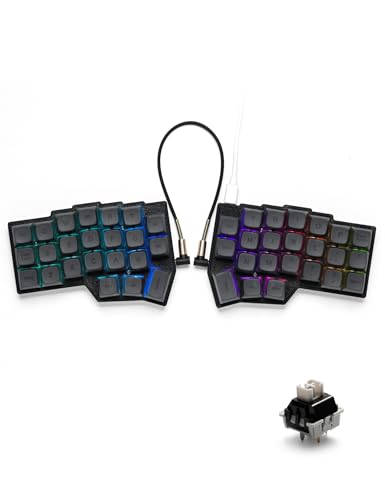 | Minimalist Innovator | Layout Type: 40% ortholinear 46‑key split | Switch Type: Linear (pre‑lubricated, hot‑swappable) | Connectivity: USB‑C wired (dual‑part) | VIEW LATEST PRICE | Read Our Analysis |
| Perixx Wireless Ergonomic Mechanical Keyboard RGB Blue Clicky |  | Wireless Powerhouse | Layout Type: Full‑size 104‑key QWERTY split | Switch Type: Low‑profile Blue clicky | Connectivity: 2.4 GHz wireless, Bluetooth, USB‑C wired | VIEW LATEST PRICE | Read Our Analysis |
| Perixx PERIBOARD-535BR Wired Ergonomic Mechanical Keyboard | Affordable Ergonomic | Layout Type: Full‑size 104‑key QWERTY split | Switch Type: Low‑profile Brown tactile | Connectivity: USB‑A wired only | VIEW LATEST PRICE | Read Our Analysis |
More Details on Our Top Picks
Adesso EasyTouch 1500 Ergonomic Mechanical Keyboard (Cherry Red RGB Bluetooth)
If you’re battling wrist strain from long typing sessions, the Adesso EasyTouch 1500 is a versatile performer that eases the load. You’ll feel the difference instantly thanks to its ergonomic shape and gasket‑structured chassis that softens each keystroke. The Cherry Red switches survive 50 million presses, and you can swap them without soldering, so you stay in control of feel and noise.
Now, the connectivity options keep you untethered: 2.4 GHz wireless, Bluetooth, or a wired USB‑A cable. You can hop between laptop, tablet, and phone with a single keystroke, and the 4000 mAh battery lasts days, so you won’t be hunting chargers mid‑project. Obviously, the battery adds a bit of weight, but it’s still lightweight enough for desk use.
Here’s the thing: the RGB backlighting isn’t just for looks. You can dial brightness down for low‑light work or set dynamic effects that help you locate the home row in a dark room. The lighting is fully programmable via VIA, and the dedicated Copilot AI hotkey launches your favorite assistant instantly. This one’s for you if you love tweaking layouts and love a bit of flair.
All right, compatibility is painless. Switch between Windows and Mac with Fn+M, and the open‑source VIA software lets you remap keys, create macros, and save profiles for each OS. The plastic enclosure feels solid, and the one‑year warranty covers any early hiccups. If you want a keyboard that adapts to your workflow without forcing you into a single mode, this is the smart, comfortable choice.
- Layout Type:Full‑size 104‑key QWERTY
- Switch Type:Cherry Red mechanical (hot‑swappable)
- Connectivity:2.4 GHz wireless, Bluetooth, USB‑A wired
- RGB Lighting:Adjustable RGB backlighting with effects
- Programmability:VIA open‑source software (layouts, macros, lighting)
- Ergonomic Features:Gasket structure, adjustable tilt, ambidextrous orientation
- Additional Feature:Hot‑swappable switches
- Additional Feature:4000 mAh battery
- Additional Feature:Copilot AI hotkey
Redragon K552P TKL Mechanical Gaming Keyboard RGB White
All right, you’re cramped on a tiny desk and need a board that won’t hog space—this compact gamer fits 87 keys into a sleek, tenkeyless frame. You’ll love the aluminum chassis; it feels solid, resists spills, and stays put while you type. The double‑shot PBT caps won’t fade, so your white‑on‑black look stays crisp after marathon sessions.
Now, the clicky Blue switches give you tactile feedback and audible clicks, perfect for fast gaming and satisfying typing. Hot‑swap lets you swap 3‑pin switches without soldering, but you’ll need a spare set if you want to experiment. N‑key rollover guarantees every press registers, even when you mash keys in a heated match.
Here’s the thing: the RGB lighting offers 18 modes, brightness, speed, and direction controlled by shortcut keys—no extra software required. You can program macros and lock Windows keys, which is handy if you switch between work and play. The dedicated multimedia keys let you adjust volume or launch a calculator without breaking focus.
Obviously, the keyboard works best on Windows; Mac support is limited, so if you’re a macOS devotee you’ll hit a few snags. It weighs a kilogram, so it’s portable but not feather‑light. If you value desk space, durability, and a satisfying click, this one’s for you. Go ahead and plug it in—your desk will thank you.
- Layout Type:Tenkeyless 87‑key QWERTY
- Switch Type:Clicky Blue mechanical (hot‑swappable)
- Connectivity:USB‑A wired only
- RGB Lighting:18‑mode RGB backlighting
- Programmability:Software + shortcut keys for macros & lighting
- Ergonomic Features:Compact tenkeyless design, ergonomic profile
- Additional Feature:Aluminum metal frame
- Additional Feature:Spill‑resistant design
- Additional Feature:Double‑shot PBT keycaps
KINESIS mWave Quiet Ergonomic Keyboard (Black)
You’ve probably spent hours battling wrist fatigue from cramped typing, and the KINESIS mWave Quiet Ergonomic Keyboard (Black) feels like a silent pro for that pain. The wave‑shaped layout and thick padded palm support keep your hands neutral, while three magnetic feet let you tilt the board negatively for extra relief. At 15.25 × 9.5 × 1.75 inches and 2.75 lb, it sits solid without hogging desk space.
All right, the Gateron Silent Red switches are low‑force, linear, and whisper‑quiet, so you won’t hear each keystroke and your fingers stay relaxed. You can pair via Bluetooth to two devices or plug in the 6‑ft USB‑C‑to‑A cable, and the included AA batteries last weeks. The only trade‑off is that you need to keep spare batteries on hand.
Now, the Kinesis Clique software lets you reprogram any key, add macros, and switch up to eight layers—perfect if you love custom shortcuts. The integrated keypad accessed by Fn, media hotkeys, and a single‑color backlight round out the feature set. This one’s for you if you value ergonomics, quiet typing, and deep programmability without a steep learning curve.
Here’s the thing: you’ll feel immediate wrist relief, and the keyboard’s versatility makes it a smart, low‑maintenance addition to any workstation. Go ahead and give it a try; you’ll notice the difference from the first session.
- Layout Type:Wave layout (ortholinear) with integrated keypad
- Switch Type:Gateron Silent Red linear (low‑profile)
- Connectivity:Bluetooth + USB‑C wired
- RGB Lighting:Single‑color backlighting (no RGB)
- Programmability:Kinesis Clique (browser‑based) for key remap, layers, macros
- Ergonomic Features:Wave layout, magnetic feet, palm support
- Additional Feature:Magnetic foot tilting
- Additional Feature:Integrated keypad layer
- Additional Feature:350+ programmable actions
Adesso EasyTouch 150 Wired Mechanical Keyboard with Cherry MX Brown Switches and Palm Rest
All right, you’re battling cramped wrists and a noisy typing experience, and the EasyTouch 150’s split‑contour shape plus palm rest gives you that “tactile classic” feel without the strain. You’ll notice the Cherry MX Brown switches provide a quiet bump that feels satisfying yet stays polite in shared spaces. The 50‑million‑press lifespan means you won’t be replacing it anytime soon, and the full‑size layout with numeric keypad keeps your workflow smooth.
Now, the built‑in CoPilot AI hotkey lets you summon Microsoft’s assistant with a single press, cutting down research time while you type. You’ll love the N‑Key rollover and anti‑ghosting for rapid data entry, especially if you juggle spreadsheets. The dual‑OS support means you can hop between Windows and Mac without extra drivers, but the plastic case feels a bit lightweight for heavy‑handed users.
Here’s the thing: this keyboard fits you if you want ergonomic comfort, tactile feedback, and quick AI access, and you don’t mind a modestly built chassis. You’ll avoid strain, stay productive, and keep your desk noise low. Go ahead and plug it in—your wrists will thank you.
- Layout Type:Full‑size 104‑key QWERTY
- Switch Type:Cherry MX Brown tactile
- Connectivity:USB‑A wired only
- RGB Lighting:No RGB backlighting
- Programmability:VIA compatible (layouts, macros, lighting)
- Ergonomic Features:Split‑key contoured shape, integrated palm rest
- Additional Feature:Split‑key contoured shape
- Additional Feature:Integrated palm rest
- Additional Feature:Dual‑OS support
YIVU CORNE V4 40% Ortholinear Mechanical Keyboard
If you spend hours typing and feel your wrists screaming, the YIVU CORNE V4 is the minimalist innovator you need. You’ll love the split 40% ortholinear layout that lets you tweak spacing, tilt, and rotation until your hands rest naturally. Three thumb keys per side keep the most common commands under your strongest digits, cutting wrist strain and the tenosynovitis risk.
Now, the hot‑swappable sockets accept 3‑pin or 5‑pin switches, so you can swap Cherry MX or pre‑lubricated linear switches without soldering. The included two‑in‑one puller makes keycap changes a breeze, and the 40 g actuation feels buttery fast for typing or gaming.
Here’s the thing: the plastic case is light and sturdy, but it won’t satisfy anyone craving a metal feel. RGB lighting offers 16.8 million colors and 45 presets via VIA/VIAL, which is great for low‑light workspaces but adds a bit of power draw.
All right, you can program every key with VIAL/QMK, creating layers that speed up your workflow. The 1.5 m USB‑C cable and 28 cm TRS link let you use each half independently, though you can’t plug both USB ports at once.
Obviously, this keyboard fits you if you value ergonomic freedom, love tinkering with switches, and don’t mind a learning curve for the ortholinear grid. If those points line up, the CORNE V4 makes a confident, low‑friction choice.
- Layout Type:40% ortholinear 46‑key split
- Switch Type:Linear (pre‑lubricated, hot‑swappable)
- Connectivity:USB‑C wired (dual‑part)
- RGB Lighting:Full‑color RGB (≈16.8 M colors) with 45 modes
- Programmability:VIAL/QMK software (full key remap, layers, lighting)
- Ergonomic Features:Split design with adjustable tilt/rotation, thumb cluster
- Additional Feature:Split adjustable layout
- Additional Feature:3 thumb keys per side
- Additional Feature:Pre‑lubricated linear switches
Perixx Wireless Ergonomic Mechanical Keyboard RGB Blue Clicky
You’re spending hours battling cramped wrists and sluggish key response, and you need a solution that actually lets you work or game without tethered cables. The Perixx Wireless Ergonomic Mechanical Keyboard splits the keys into left and right zones, curving rows and caps so your hands rest naturally. Stepped caps and adjustable tilt—0°, –4°, –7°—let you fine‑tune posture, and a 3D‑printed block can lock the legs if you need extra stability.
All right, the connectivity is solid: one USB‑C wired mode, a 2.4 GHz dongle, and two Bluetooth slots, all plug‑and‑play with no drivers. You can hop between Windows and Mac layouts instantly, and the US English layout comes standard, while other languages require a minimum order.
Now, the keyboard feels clicky and fast thanks to low‑profile blue switches that give a loud, tactile snap and rapid reset. RGB lighting adds flair, and the software lets you program ten macros and rearrange keys, which is handy for gamers or power‑users. The built‑in 3000 mAh battery lasts up to a month on 6‑8 hours daily use, and you can charge via USB‑C or stay wired for zero latency.
Obviously, the plastic case keeps weight at 2.47 lb, so it’s portable but not ultra‑light; the ambidextrous seven‑section design may feel bulky on cramped desks. This one’s for you if you crave wireless freedom, ergonomic shape, and clicky feedback, and you don’t mind a bit of extra heft. The 12‑month warranty backs you up, making the decision straightforward and confidence‑boosting.
- Layout Type:Full‑size 104‑key QWERTY split
- Switch Type:Low‑profile Blue clicky
- Connectivity:2.4 GHz wireless, Bluetooth, USB‑C wired
- RGB Lighting:Customizable RGB backlighting
- Programmability:Software for macros, lighting, media keys
- Ergonomic Features:Split‑key layout, curved rows, adjustable tilt legs
- Additional Feature:3‑D printed leg block
- Additional Feature:3000 mAh rechargeable battery
- Additional Feature:7‑section ambidextrous design
Perixx PERIBOARD-535BR Wired Ergonomic Mechanical Keyboard
You’ve probably felt wrist strain after hours of typing, and the split‑key layout of the Perixx PERIBOARD‑535BR cuts that bending right off, making an affordable ergonomic solution feel like a no‑brit. The curved rows and stepped caps guide your hands into a natural posture, so after a week or two you’ll notice less fatigue. All right, the low‑profile brown tactile switches give you a satisfying bump without the clicky clatter, perfect for coding or long essays.
Now, the 104‑key N‑Key Rollover stops ghosting, and you can re‑program keys on Perixx’s site—no extra software needed. It plugs into any USB‑A port, works on Windows, macOS, Linux, and stays under two pounds, so you can move it between laptop and desktop without hassle. Obviously, the plastic case isn’t premium metal, but the price‑to‑comfort ratio beats most high‑end rivals.
Here’s the thing: this keyboard fits you if you want ergonomic relief without breaking the bank and don’t mind a modest learning curve. The 12‑month warranty and 30‑day Amazon return give you a safety net, so you can try it risk‑free. Go ahead and give your wrists a break—your fingers will thank you.
- Layout Type:Full‑size 104‑key QWERTY split
- Switch Type:Low‑profile Brown tactile
- Connectivity:USB‑A wired only
- RGB Lighting:No RGB backlighting
- Programmability:Perixx web portal for key programming (no software install)
- Ergonomic Features:Split‑key layout, curved rows, stepped keycaps, adjustable tilt legs
- Additional Feature:Low‑profile brown tactile switches
- Additional Feature:Custom programming via website
- Additional Feature:12‑month limited warranty
Factors to Consider When Choosing Ergonomic Keyboards With Mechanical Switches
You’re probably frustrated by cramped wrists and inconsistent keystrokes, so let’s sort out the ergonomic layout, switch type, and key travel before you buy. If you crave a split or curved design, a tactile or linear switch, and a travel distance that matches your typing speed, pick the model that lets you adjust tilt and program macros for your workflow. Obviously, the right combo feels natural for you, and once you match those specs, the decision becomes a no‑brainer.
Ergonomic Layout Design
When your hands feel like they’re doing gymnastics on a flat board, a split‑key layout can instantly give them the shoulder‑width stretch they crave, cutting down ulnar deviation. You’ll notice the left and right zones sit naturally under each wrist, so you stop fighting a cramped posture. All right, if you add a curved row, your fingers follow a gentle arc instead of a straight line, reducing extension and keeping the wrist neutral.
Now, consider a palm rest that’s built‑in or easily attached; it supports the forearm and stops the wrists from bending upward. Adjustable tilt legs let you dial in a negative angle, further easing wrist extension. If you prefer column‑staggered or ortholinear keys, lateral finger movement drops, which can be a game‑changer for long sessions.
Here’s the thing: this design works best if you type for hours and value comfort over a classic look. Trade‑offs? You’ll sacrifice some desk space and may need a learning curve for non‑standard key positions. But once you adapt, the strain disappears. Choose the layout that matches your hand shape, and you’ll type faster without pain.
Switch Type Preference
If the thought of finger fatigue keeps popping up, you’ll want a switch that matches your typing rhythm. You’re likely hunting for smooth, quiet linear switches if you glide through code, or a tactile bump when you need that subtle feedback without a click. Obviously, actuation force matters—lighter (45 g) reduces effort, while heavier (60 g) can deter accidental presses.
All right, consider longevity. A 50‑million‑stroke rating means you won’t replace the board for years, but hot‑swappable designs let you experiment later. If you love swapping feels, a hot‑swap board saves soldering headaches and keeps your setup fresh.
Now, low‑profile switches shrink height and travel, easing strain for those with shallow hand arches. This one’s for you if you crave a slimmer profile and faster key resets. Choose the switch family that aligns with your comfort goals, and you’ll type with confidence, not compromise.
Key Travel Distance
All right, you’re probably feeling the ache of long‑haul typing and wondering whether a short‑travel switch will actually ease that strain. The key travel distance is the vertical span from rest to bottom‑out, and the actuation point sits partway through. Short travel, around 2 mm, lets you flick keys faster and cuts finger movement, which can lessen fatigue on marathon sessions.
Now, if you crave that classic clicky feel and a pronounced tactile bump, you’ll enjoy longer travel—up to 4 mm—because the extra distance gives a satisfying rhythm and clearer feedback. The trade‑off? More finger motion, which can feel tiring if you type lightly or have smaller hands.
Obviously, the sweet spot depends on your typing style. If you’re a speed‑focused gamer, low‑profile switches win; if you’re a coder who loves the “punch” of a full‑travel key, go deeper. Choose the travel that matches how hard you press, and you’ll feel the difference instantly.
Adjustable Tilt Mechanisms
All right, you’ve just felt how travel distance changes finger fatigue, and now you’ll notice that a keyboard’s tilt can either amplify or calm that strain. You probably know that a negative tilt—front edge lower—helps keep your wrists neutral, cutting extension and easing the carpal tunnel. If you like tweaking, look for keyboards with detachable magnetic feet or multiple preset angles like 0°, ‑4°, ‑7°; they let you match the surface to your forearms and reduce ulnar deviation.
Here’s the thing: a stable tilt is non‑negotiable. Some cheap designs wobble under fast typing, so check for reinforcement or a solid base. You’ll love a tilt that locks firmly, especially if you type aggressively.
Obviously, tilt works best with split layouts, so if you already have a split board, a negative‑tilt mechanism will complement it and lower shoulder strain. This one’s for you if you want a customizable, sturdy angle that syncs with your ergonomic setup. Adjust, test, and you’ll feel the difference instantly—no guesswork needed.
Programmable Macro Support
All right, you’ve probably hit a wall when a single key can’t do the whole workflow you need, and that frustration stalls productivity. You’ll love a keyboard that lets you bind a multi‑step command to one press, so you stop juggling mouse clicks and extra keys. The software usually runs in a browser or a lightweight app, and you can edit, save, and share your keymaps without digging into firmware.
Now, think about layers. A good ergonomic board offers two or three programmable layers, letting you reach hundreds of actions while keeping the base layout comfortable. If you need mouse clicks, system commands, or timed delays, look for a model that records those sequences; otherwise you’ll end up with a half‑baked macro that breaks your flow.
Here’s the thing: tap‑and‑hold adds another dimension. Tap for a regular character, hold for a shortcut or macro—perfect for coders who need both letters and IDE commands on the same key. This feature shines on compact layouts, but if you rarely use hold actions, you might be paying for complexity you don’t need.
Obviously, not every keyboard supports all these tricks. If you’re a power user who lives in spreadsheets or video editing, the extra layers and mouse‑recording are worth the learning curve. If you just want a few shortcuts, a simpler macro‑only board keeps things tidy and cheap.
Choose the one that matches your workflow depth. If you crave full‑blown automation, go for the multi‑layer, tap‑and‑hold model; if you only need a couple of shortcuts, a single‑layer macro board does the job. Either way, you’ll feel the speed boost instantly.
Connectivity Options Overview
All right, you’re stuck choosing between a cord that never dies and a wireless setup that promises freedom but eats battery. You know wired USB‑C gives you a rock‑solid, always‑on link—no pairing, no charge worries, just plug and type. If you travel, the 2.4 GHz dongle offers low‑latency, plug‑and‑play performance, while Bluetooth lets you juggle three devices, but you’ll watch that 4000 mAh battery drain if you forget to charge.
Now, think about split keyboards that need a TRS cable between halves; that cable isn’t for data, so you still need a USB connection for the computer. Some models let you run a 2.4 GHz receiver and two Bluetooth links at once, so you can flip from desktop to laptop to tablet without hassle. Obviously, the more connections you have, the more you’ll need to manage pairing and power.
Here’s the thing: if you value zero‑latency and never want to worry about a dead battery, stick with wired. If you crave a clutter‑free desk and can tolerate occasional recharging, go wireless with a strong battery. Choose the combo that matches your workflow, and you’ll feel confident, not confused.
RGB Lighting Customization
You know the frustration of a dark desk and missing a key just because the backlight’s too dim, and you’re not alone. All right, start by checking whether the keyboard offers preset modes like rainbow, breathing, or rhythmic patterns; they let you switch moods without digging into menus. Now, look at brightness, animation speed, and direction controls—most models let you tweak those on the fly with shortcut keys or a companion app, so you can keep the glow just bright enough for low‑light typing but not blinding.
If you love tweaking colors, pick a board that supports roughly 16.8 million hues; that range lets you craft a personal palette that matches your setup. Open‑source software is a hidden gem—if you enjoy programming, you can assign lighting behaviors to different layers, making each profile instantly recognizable. Remember, backlighting is first and foremost functional; it helps you locate keys when the room’s dim, while the visual flair stays a bonus.
Obviously, not everyone needs a full‑blown light show; if you work in a shared office, a subtle single‑color backlight might be less distracting. This one’s for you if you want both practicality and a splash of personality without sacrificing ergonomics. Choose the scheme that feels natural, and you’ll type faster, knowing every key is visible and your desk looks cool.
Battery Life Considerations
If your desk is a battlefield of low‑light chaos, you’ll feel the sting of a dead keyboard mid‑session. You’re typing, the game’s on, and the lights flicker out because the battery gave up. That frustration is why you must match capacity to usage: a 4000 mAh pack keeps you alive for weeks, while 3000 mAh stretches a 6‑hour day into a month on a single charge.
All right, now consider replaceable AA cells. They’re cheap, easy to swap, and never lock you into a charging schedule, but you’ll carry spares and risk inconsistent voltage. Wireless‑only models demand constant monitoring; a sudden dip forces you to pause and plug in, breaking flow.
Obviously, portability hinges on battery life. If you travel daily, a high‑capacity built‑in battery wins; if you stay put, AA cells might suit you better. Choose the power plan that mirrors your routine, then you’ll type without interruption.